
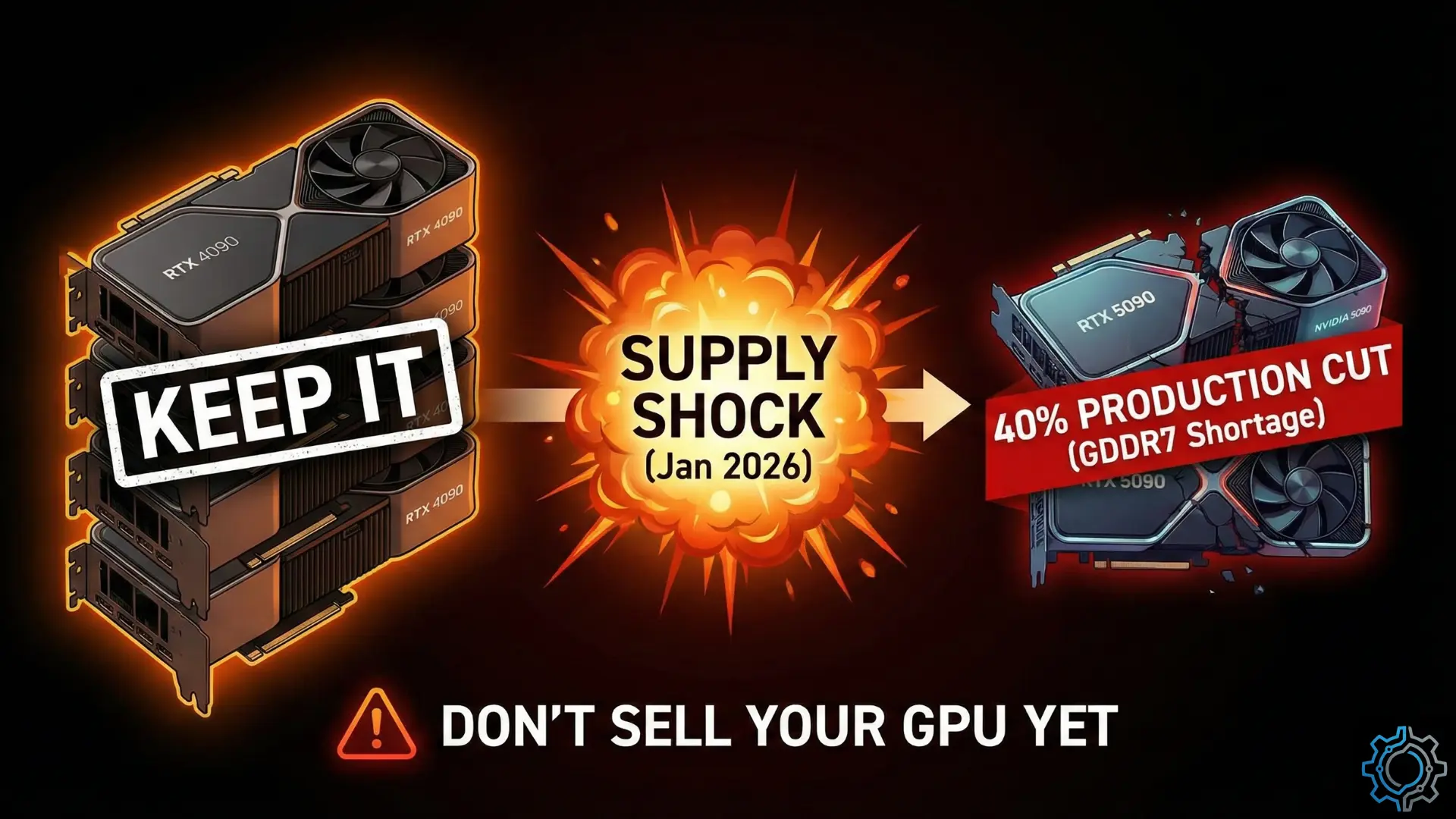
I was in the middle of cleaning the test bench yesterday, prepping it for the massive “January Upgrade” we were all planning. Like many of you, I had my eBay draft ready to sell my lab’s RTX 4090, expecting to use that cash for the shiny new RTX 5090 launching at CES 2026 in just a few weeks.
Then, my notification feed lit up with reports from the upstream supply chain in Taiwan and China.
If you are planning to build a new PC or upgrade your GPU in January 2026, stop and read this log immediately. The “easy upgrade” we were promised is about to become a bloodbath.
Multiple credible sources from the manufacturing floors (including reports from Board Channels and Benchlife) have leaked that NVIDIA is reportedly slashing the initial supply of RTX 50-series cards by up to 40% for the first half of 2026.
Table of Contents
This isn’t a “maybe.” The orders for GDDR7 memory modules have been cut. This means there will likely be almost half the stock we expected on launch day. If you sell your current card today, you might find yourself with no GPU in January and no way to buy a replacement without paying double.
The Diagnosis: The “GDDR7 Yield” Crisis
Why would NVIDIA, a company whose primary goal is to sell us hardware, refuse to make enough of their highly anticipated product? It’s not malice; it’s a brutal combination of physics and economics.
The root cause of the NVIDIA supply shock can be traced to three specific points of failure in the manufacturing process of the new GDDR7 memory standard.
1. The “AI” Problem (Again)
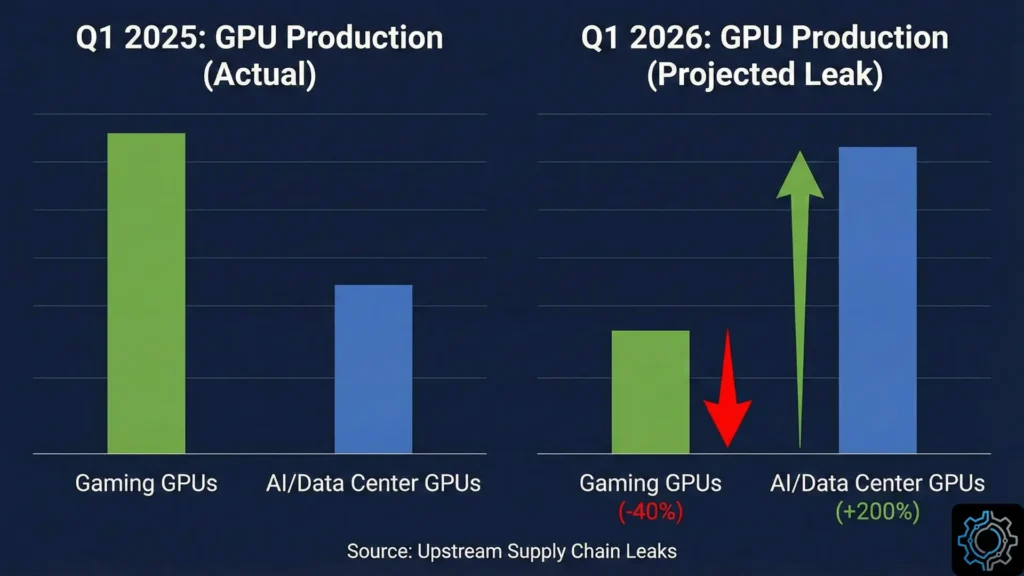
The new RTX 5090 and 5080 rely on cutting-edge GDDR7 memory to achieve their massive bandwidth targets. The problem? The same semiconductor foundries (Micron, Samsung, and SK hynix) that make GDDR7 are currently running their lines at 100% capacity to produce HBM3e (High Bandwidth Memory) for AI data center accelerators like NVIDIA’s own Blackwell B200 AI chips.
AI chips have exponentially higher profit margins than consumer gaming cards. When push comes to shove, the foundries will prioritize the clients paying top dollar. The gaming memory lines are simply getting squeezed out for more profitable AI silicon.
2. The Yield Rate Failure
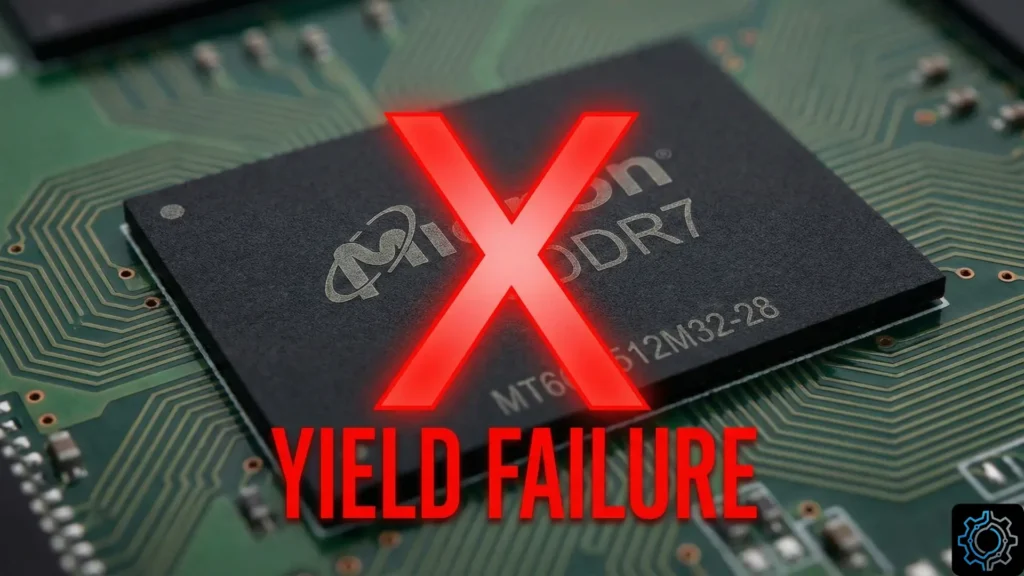
This is the more technical, and more worrying, part of the leak. The reports suggest that the “yield rate” (the percentage of perfect chips produced from a silicon wafer) for the new high-density 3GB GDDR7 modules is lower than expected.
Manufacturing new memory technology is notoriously difficult. For every 100 memory chips they try to make, a significant portion are failing quality tests. They physically cannot make enough perfect memory modules to put on the PCBs of the millions of GPUs gamers want to buy.
3. The “Priority” Shift
The leak indicates that NVIDIA is making a strategic choice about which cards get the limited supply of good GDDR7 memory. The RTX 5070 Ti and RTX 5060 Ti (16GB) will be the first victims. These cards were supposed to be the “value kings” of 2026, bringing high-VRAM gaming to the masses. Now? They are looking like “paper launches”—products that exist in YouTube reviews but not on store shelves. NVIDIA will save the few good memory chips they have for the flagship RTX 5090, where they make the most profit per unit.
The Impact: Welcome Back to 2021?
I vividly remember the GPU shortage of 2020-2021. I logged hundreds of hours helping you guys find cards, track drops, and avoid scams. The signs right now are terrifyingly similar, and if we don’t prepare, history is about to repeat itself.
- Scalpers are Ready: Bot networks that have been dormant since the end of the crypto boom are being updated and re-activated for the January 6th launch. With 40% less stock available globally, they will be able to corner the market almost instantly.
- Price Inflation: The rumored MSRP for the RTX 5090 is $1,999. However, MSRP means nothing when there is no stock. If the supply is truly cut by 40%, street prices on eBay and third-party sellers could easily hit $3,000+ within 24 hours of launch.
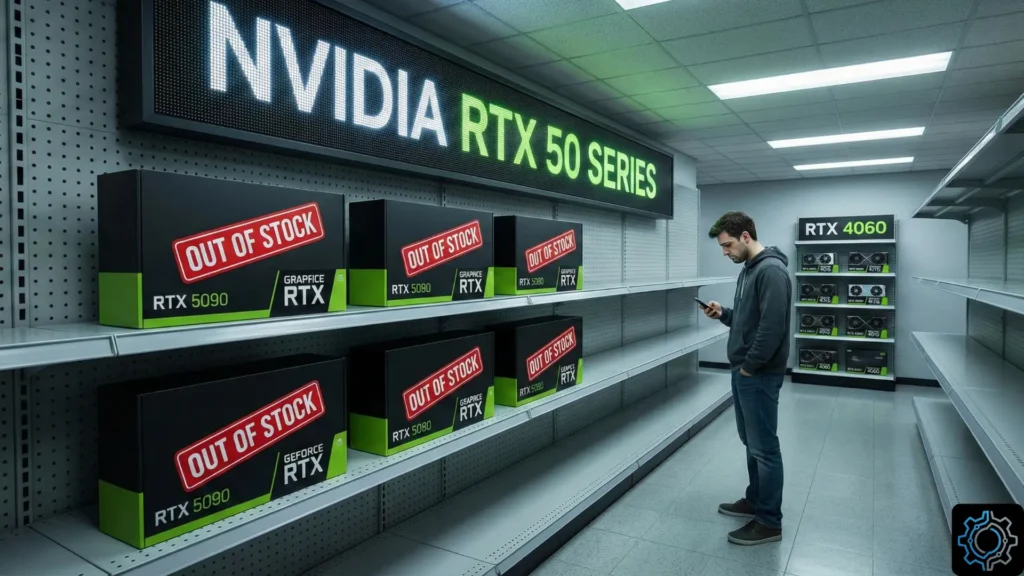
- Retailer Chaos: Expect websites to crash, lotteries to return, and brick-and-mortar stores to have lines forming days in advance. The “casual” buyer who just wants to walk in and buy a card will be completely locked out.
My “Technician’s Advice” (Action Plan)
I don’t want to see any of my readers scammed or left without a working PC for six months. Based on this new intelligence, here is my verified, practical advice for navigating the coming storm.
1. DO NOT Sell Your Current Card Yet This is the most important rule. If you have a working RTX 3080, 3090, or any 40-series card, hold onto it with your life. Do not list it on eBay “in anticipation” of buying a 50-series card. If you sell it today, you might find yourself with a pile of cash, no new GPU to buy in January, and no way to buy your old card back without paying a premium. Your current GPU is your insurance policy.
2. The “Pre-Order” Strategy (If You MUST Buy) If you are a professional who absolutely needs an RTX 5090 for rendering, machine learning, or game development:
- Set up notifications now: Use trackers like NowInStock.net or join Discord servers dedicated to stock alerts.
- Do not aim for the “Founders Edition”: NVIDIA’s own cards will be the most sought-after and will vanish in seconds.
- Target the “ugly” AIB cards: Brands like Zotac, PNY, or Palit often have stock that lasts a few minutes longer than premium brands like ASUS ROG or MSI Suprim, simply because gamers don’t like their aesthetic. If you need the performance, don’t be picky about the cooler design.
3. Look at the Used Market NOW Ironically, this news makes the RTX 4090 incredible value all over again. If the 5090 is unobtainable or $3,000, the 4090 remains the undisputed king of gaming performance. If you can find a well-cared-for, used RTX 4090 for under $1,200 today, buy it. By February, when the panic sets in, that same used card could easily be selling for $1,600 or more.
4. What About AMD and Intel? Don’t count on them to save us.
- AMD’s RDNA 4 cards are rumored to be mid-range only (competing with the RTX 4070), so they won’t satisfy high-end demand.
- Intel’s Battlemage just launched (Arc B580), and while promising, it’s suffering from early driver issues and isn’t a flagship competitor. NVIDIA has a monopoly on the high-end, and the supply shock will reflect that.
Conclusion: The Wait Begins
I am personally delaying my own test bench upgrade. I cannot in good conscience sell my lab’s RTX 4090 when the supply of its replacement is this volatile.
We were all hoping that 2026 would be the year of “Affordable 4K Gaming” and easy upgrades. Instead, it looks like it will be the year of “The Great Supply Squeeze Part II.”
Prepare your PCs, manage your expectations, and do not make any rash decisions with the hardware you currently own. I will continue to monitor the situation closely and will update this log #NVIDIA-SUPPLY-2026 the moment I get official allocation numbers from our local distributors here in India.
Stay vigilant.
🛡️ Verification Log
- Leak Source: Board Channels (China) / Benchlife / Upstream Supply Chain Reports
- Impacted Hardware: NVIDIA GeForce RTX 5090, RTX 5080, RTX 5070 Ti, RTX 5060 Ti (16GB)
- Root Cause: Global GDDR7 Memory Shortage, Low Yield Rates, AI Data Center Prioritization
- Status: CRITICAL WARNING / HIGH RISK OF SHORTAGE
Frequently Asked Questions (FAQs)
Q1: Has NVIDIA officially confirmed this production cut?
A: No, and they likely never will. Companies rarely announce “negative” news like supply shortages before a launch. This information comes from “Board Channels” and upstream supply chain reports in Taiwan, which track the movement of raw components. Historically, these leaks (like the ones predicting the RTX 30-series shortage) have been accurate indicators of market health.
Q2: Why does the AI boom affect my gaming graphics card?
A: It comes down to manufacturing capacity. The factories that produce high-end memory chips (Micron, Samsung) have limited space. Currently, NVIDIA is prioritizing “HBM3e” memory for its AI chips (Blackwell B200) because they sell for $30,000+ per unit. Gaming GPUs use similar production resources but yield far less profit. The foundries are simply following the money, leaving less room for GDDR7 gaming memory.
Q3: Should I panic-buy an RTX 4090 right now?
A: Do not “panic buy,” but be strategic. If you find a new RTX 4090 at MSRP ($1,599) or a used one in good condition for under $1,200, it is a safe purchase. I would not pay scalper prices ($2,000+) for a 4090 today, but I certainly wouldn’t sell one if I already owned it.
Q4: Will the shortage affect the budget cards like the RTX 5060?
A: Yes, potentially even more so. The leaks suggest that NVIDIA might delay the launch of the mid-range cards (RTX 5060 / 5060 Ti) entirely to save GDDR7 chips for the high-end 5090. If the yield rates are poor, it makes no financial sense to put a precious memory chip into a cheap $400 card when it could go into a $2,000 flagship.
Q5: Will AMD RDNA 4 cards face the same shortage?
A: Likely not, but for a different reason. Rumors suggest AMD is sticking to older GDDR6 memory for many of its upcoming RDNA 4 cards. Since GDDR6 is mature and easy to manufacture, AMD might actually have better stock availability. However, their top card will likely only compete with the RTX 4070, not the 5090.
Q6: When do you expect stock to actually normalize?
A: Based on typical semiconductor cycles, if the shortage hits in Q1 2026 (January-March), we won’t see stabilization until Q3 2026 (July-September). It takes months to ramp up new production lines or improve yield rates on new tech like GDDR7.
Q7: Will laptops with RTX 50-series chips be affected?
A: Absolutely. Laptop GPUs use the same architecture and memory supply chain. If desktop cards are scarce, high-performance gaming laptops featuring the “RTX 5090 Mobile” will likely be in very short supply and carry a massive “early adopter” tax.
Q8: If I manage to order a card on launch day, will it ship immediately?
A: Be careful with “Pre-Orders.” In 2021, many retailers took orders for cards they didn’t physically have. If you buy a card on backorder, you might be waiting 3-4 months. Only buy if the site confirms “In Stock” and ready to ship.
Q9: Is the RTX 5090 really worth the headache?
A: Only if you are pushing 4K 240Hz monitors or doing professional work. For 1440p gaming, the current RTX 40-series is still overkill. Do not let FOMO (Fear Of Missing Out) force you into a battle for a card you might not actually utilize fully.
Q10: Can I just wait for the “Super” refresh in 2027?
A: If your current PC plays your favorite games at 60FPS+, waiting is the smartest financial move. By 2027, the GDDR7 manufacturing process will be mature, yields will be high, and prices will (hopefully) come down. The “early adopter” tax in 2026 is going to be painful.