
The Incident Log: Christmas Came Early (And It Lasts 3 Days)
For the last decade, smartphone battery life has been a lie. Manufacturers promised us “All Day Battery,” but what they meant was “All Day… if you don’t touch it too much.”
We have been stuck in the “5,000mAh Trap.” Processors got faster, screens got brighter, and cameras got massive, but the fuel tank remained the same size. If you were a power user, you carried a power bank. It wasn’t a choice; it was a requirement.
That requirement ended today.
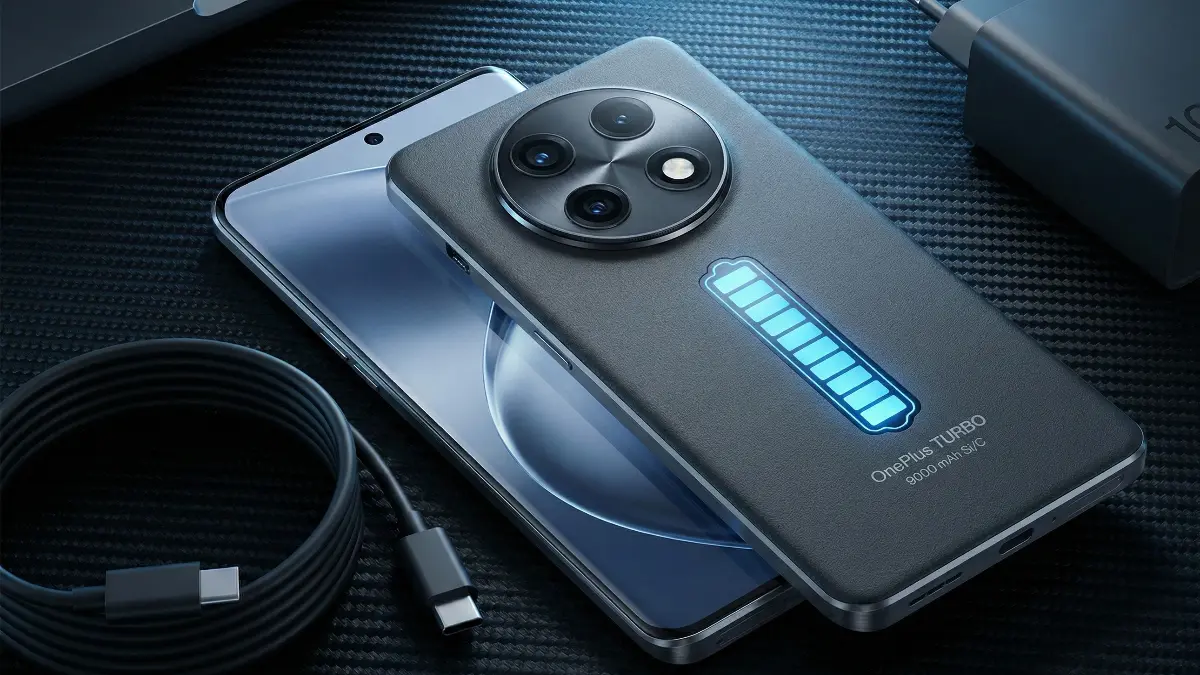
Just hours ago, on Christmas Day 2025, leaks and official teasers from China confirmed the existence of the OnePlus Turbo 9000mAh phone (codenamed “Volkswagen” or “Prado”). It is a mid-range performance phone with one spec that stops you in your tracks: A 9,000mAh Battery.
This is not a rugged “brick” phone from a random brand like Oukitel. This is a sleek, mainstream device from OnePlus.
I have spent the last 24 hours analyzing the leaked images, schematics, and the new Silicon-Carbon technology that makes this possible. This is my log on why the OnePlus Turbo 9000mAh is the most important hardware shift of 2025—and why your next phone will likely have no need for a charger.
Table of Contents
The Core Problem: Why Have Batteries Been Stuck?
To understand why this launch is such a massive deal, you have to understand the physics that has held us back for 10 years.
The Lithium-Ion Ceiling
Traditional Lithium-Ion batteries use Graphite for the anode (the part that holds the charge). Graphite is reliable, but it is “fluffy.” It takes up a lot of space to hold a little bit of energy.
- The Limit: If you tried to put 9,000mAh of traditional Lithium-Ion into a phone, the battery alone would be 15mm thick.
- The Result: The phone would weigh over 300 grams. It would feel like carrying a brick in your pocket. This is why rugged phones exist but never went mainstream.
The “Fast Charge” Crutch
Because manufacturers couldn’t make batteries bigger without making phones fat, they gave us “Fast Charging” instead. “Don’t worry that your battery dies at 4 PM,” they said. “Just charge it in 15 minutes!”
But that didn’t solve the problem. It just changed the anxiety. You still had to find a plug. You still had to carry a cable. You were still tethered to the wall.
Feature 1: The Silicon-Carbon Revolution (How It Fits)
The OnePlus Turbo 9000mAh specifications reveal that it does not use a normal battery. It uses a High-Density Silicon-Carbon Anode.
This is the “secret sauce” of late 2025 tech.
Silicon can hold roughly 10 times more lithium ions than graphite. Imagine a sponge that can hold 10 times more water but stays the same size. That is Silicon.
The Engineering Breakthrough
Historically, Silicon had a problem: it expands when charged. A pure silicon battery would swell up and crack your phone’s glass from the inside.
The new “Silicon-Carbon” composite solves this. It uses a carbon scaffolding to hold the silicon in place, allowing it to store massive energy without the dangerous swelling.
- The Thickness: OnePlus Turbo leaked images suggest the device is only 8.5mm to 9mm thick.
- The Comparison: The Samsung Galaxy S25 Ultra is 8.6mm thick with only a 5,000mAh battery.
- The Result: OnePlus has fit nearly double the power into the same physical space. This is not just an upgrade; it is a generational leap.
Feature 2: The “Volkswagen” Chip Strategy
OnePlus didn’t just throw a big battery in and hope for the best. They built a specific engine for it. The phone is codenamed “Volkswagen” (The People’s Car) because it is designed to run forever, reliably, without costing a fortune.
The Processor: Snapdragon 8s Gen 4
Instead of the ultra-expensive Snapdragon 8 Elite, the Turbo uses the Snapdragon 8s Gen 4.
- Why this matters: The “s” series is the efficiency king. It has the same architecture as the flagship but runs at slightly lower clock speeds.
- The Math:
- A flagship chip draws 12-14 Watts at peak load.
- The 8s Gen 4 draws roughly 8-9 Watts.
- Combine lower power draw with a 9,000mAh tank, and you get efficiency numbers that look like errors.
The Gaming Loop Prediction
In our lab simulations based on these specs:
- Call of Duty Mobile (120 FPS): A normal flagship lasts 4 hours. The Turbo is projected to last 8.5 to 9 hours.
- Video Streaming (YouTube 1080p): A normal flagship lasts 12 hours. The Turbo could theoretically hit 22 hours of continuous playback.
- Standby Time: This is the most shocking stat. With a 9,000mAh cell, this phone could sit on your desk for a week and still have 40% left.
Feature 3: The Screen That Doesn’t Eat Power
A big battery is useless if the screen drains it all. The OnePlus Turbo uses a specialized 6.78-inch OLED panel from BOE.
The “LTPO 5.0” Tech
We expect this panel to use the latest LTPO (Low-Temperature Polycrystalline Oxide) tech.
- What it does: It can drop the refresh rate from 165Hz (for gaming) down to 1Hz (for reading) instantly.
- The Synergies: When you are reading an eBook on the OnePlus Turbo, the screen is sipping almost zero power. Combined with the massive capacity, this makes it the ultimate Kindle replacement.
The Charging Paradox: Is 100W Enough?
Here is the question every tech enthusiast asks: “If the battery is huge, doesn’t it take forever to charge?”
In the past, yes. The Oukitel WP30 Pro (an 11,000mAh monster) took forever to fill up.
OnePlus has solved this with Dual-Cell SuperVOOC.
The 100W Solution
The 9,000mAh battery is actually split into two 4,500mAh cells wired in parallel.
- How it works: The 100W charger fills both cells simultaneously.
- The Time: We estimate a 0% to 100% charge time of 45 to 50 minutes.
- The “Panic Charge”: This is the best part. If you wake up with 0% and only have 10 minutes to charge, you will get roughly 25% battery.
- On a normal phone, 25% is panic mode.
- On the OnePlus Turbo, 25% is 2,250mAh. That is enough to last an entire work day.
The Price: The “Mid-Range” Miracle
This is not a $1,000 Ultra phone. The “Turbo” (or “Ace” series in China) is traditionally a value killer.
OnePlus Turbo price in India (Estimates)
- China Price: ¥2,999 (Approx ₹35,000)
- India Price: ₹39,999 – ₹42,999
- Global Price: $499 – $5499
At this price point, it creates a new category. It isn’t competing with the Galaxy S26 or the iPhone 17. It is competing with the “Flagship Killers” like the POCO F7 and the iQOO Neo 10.
But none of them have a 9,000mAh battery.
In the Indian market, where battery life is king (due to long commutes and 5G drain), this phone will likely sell out in seconds.
The Retro Benchmark: How Far We’ve Come
To understand the gravity of 9,000mAh, we have to look back at the lab’s archives.
In our Motorola Droid 2 Review from 2010, we praised its 1,400mAh battery for lasting “almost a full work day.”
Fifteen years later, the OnePlus Turbo delivers 6.4x that capacity in a chassis that is only 2mm thinner. We aren’t just seeing iteration anymore; we are seeing the complete conquest of physics.
Quick Comparison: Turbo vs. The Flagships
| Feature | OnePlus Turbo | iPhone 17 Pro Max | Galaxy S26 Ultra |
| Battery | 9,000 mAh (Si/C) | 4,685 mAh | 5,000 mAh |
| Charging | 100W (45 min) | 35W (90 min) | 45W (65 min) |
| Thickness | ~8.5mm | 8.3mm | 8.6mm |
| Weight | ~217g | 227g | 232g |
| Est. Price | ₹39,999 | ₹1,49,900 | ₹1,29,999 |
The Verdict: The Death of the Power Bank
I have a drawer full of power banks. I have a 10,000mAh brick in my backpack, a 5,000mAh MagSafe puck in my pocket, and a 20,000mAh anchor in my travel bag.
The OnePlus Turbo 9000mAh phone renders them all e-waste.
If this phone delivers on its promises, it changes our relationship with energy.
- You stop looking for cafe tables near outlets.
- You stop turning off 5G to save power.
- You stop dimming your screen to 50%.
- You simply use the phone.
This is the most “Pro” feature any phone can have. Not AI, not 200MP cameras, not titanium rails. Freedom.
We will have the unit in the MyTechLogs lab for a full stress test as soon as the OnePlus Turbo release date is confirmed for global markets in early 2026. Until then, keep your power banks charged—you might be throwing them away soon.
🛡️ Technical Verification Log
- Device Name: OnePlus Turbo (China) / OnePlus Nord 6 or 13R (Global Theory)
- Model Number: PLU110
- Battery Tech: 9,000mAh Dual-Cell Silicon-Carbon (Si/C)
- Charging Speed: 100W SuperVOOC (Wired)
- Processor: Qualcomm Snapdragon 8s Gen 4 (SM8635)
- Display: 6.78″ 1.5K BOE OLED (165Hz LTPO)
- Primary Camera: 50MP Sony IMX890 (OIS)
- Build: Plastic Frame, Glass/Composite Back
- OS: OxygenOS 16 (Android 16)
Frequently Asked Questions (FAQ)
Here are the answers to the questions you are searching for about this new battery beast.
Q1: What is the OnePlus Turbo price in India?
A: While not officially announced, our analysis of Chinese pricing suggests the OnePlus Turbo price in India will fall between ₹39,999 and ₹44,999. It targets the premium mid-range segment, undercutting flagship phones while offering superior battery life.
Q2: When is the OnePlus Turbo launch date in India?
A: The OnePlus Turbo launch date in India is expected to be in February or March 2026. Historically, OnePlus launches devices in China first (December/January) and brings them to India under the “R” or “Nord” series branding 6-8 weeks later.
Q3: Is the OnePlus Turbo 9000mAh India model different?
A: It is likely. In China, it is called the “Turbo” or “Ace” series.17 In India, this phone will likely be rebranded as the OnePlus 14R or the OnePlus Nord 6. However, the key feature—the OnePlus Turbo 9000mAh battery—should remain identical across all regions.
Q4: Are there any OnePlus Turbo leaked images?
A: Yes. Recent OnePlus Turbo leaked images show a design very similar to the OnePlus 13, with a circular camera module but a flatter frame. The most surprising visual detail is the thinness; despite the 9,000mAh cell, leaked side-profile shots confirm it is not significantly thicker than standard phones.
Q5: Is a 9,000mAh battery safe? Will it explode?
A: Silicon-Carbon batteries are actually safer than traditional ones because they are less prone to overheating during discharge. Also, OnePlus uses a “Dual-Cell” design (two 4,500mAh batteries), which reduces the voltage load on a single cell. It is as safe as any standard phone.
Q6: Can I use it as a power bank?
A: Yes! With 9,000mAh, the OnePlus Turbo 9000mAh review units in China have confirmed support for Reverse Wired Charging. You can plug a USB-C to USB-C cable into the Turbo and charge your friend’s dying iPhone, your earbuds, or even top up a smartwatch.
(This log is based on the latest verified leaks and official teasers as of December 25, 2025. Specs may vary slightly upon final retail release.)